


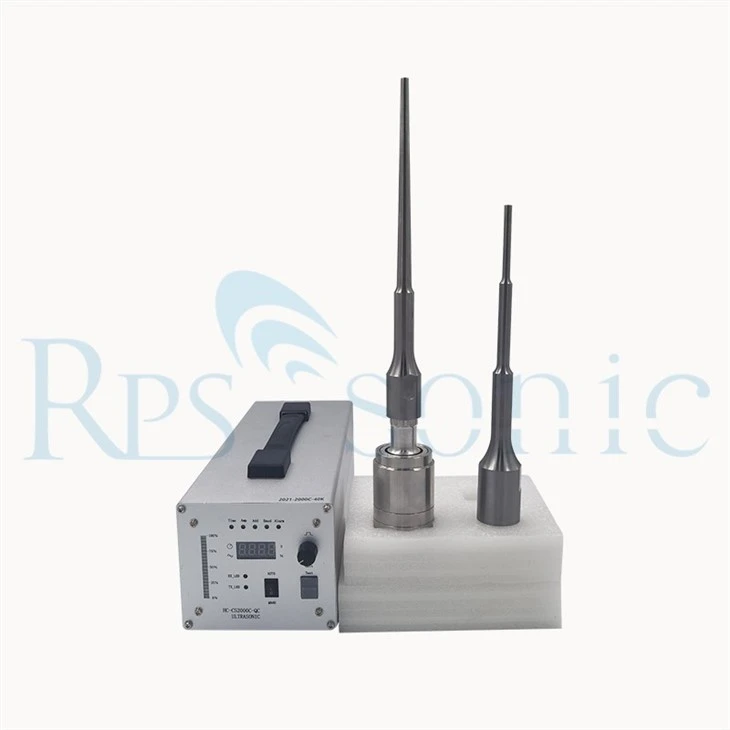
Ultrasonic Probe Homogenizer
In modern laboratories, ultrasonic homogenizes are used to break cell walls to extract the cell contents, e. g. the proteins without damaging them. A part of the energy introduced into the cell suspension is transformed into heat by friction.
Product Details
Description:
In modern laboratories, ultrasonic homogenizes are used to break cell walls to extract the cell contents, e. g. the proteins without damaging them. A part of the energy introduced into the cell suspension is transformed into heat by friction. In order to avoid thermal damage to the cell contents, the sample is either cyclically intermittent sonicated or cooled in a cooling vessel during sonication. A rosette cell enables a uniform sonication of microorganisms as the ultrasonic energy forces the sample to circulate repeatedly under the probe and through-out the side arms. Placed in the ice bath, the content can be cooled effectively due to the enlarged glass surface.
The disruption of cell membranes depends strongly on the elasticity of the cells. Cell components, such as mitochondria or cytoplasm, can be disrupted fractionally by varying the input ultrasonic energy and thus the extraction power. In the case of particularly resistant bacteria (for example streptococci), fungi, spores, yeasts or tissue samples, direct destruction with very high ultrasonic amplitudes via micro tips is possible, since micro tips can achieve a very large energy input into smallest sample quantities.
When working with microliter quantities, foaming and splashing out of the vessel are a bigger problem. A valuable sample material loss is possible. Therefore the power regulation is very important. If cells with labile walls are to be disrupted, only little power or small amplitude is necessary.
In order to dissolve large quantities continuously, special flow vessels made of glass or stainless steel with a sonication chamber are used to treat each particle of a suspension with the same intensity. Thermal damages to cell contents can be excluded if the vessel is additionally equipped with a cooling jacket. In order to avoid contamination by foreign particles - for example erosion particles of the probe - an indirect sonication in a cup booster or cup horn is to be preferred. This method achieves uniform intensity and cooling.
Parameter:
Item | Parameter |
Power: | 1000W in max |
Frequency: | 20Khz |
Transducer : | 5020-4D |
Booster: | 1:2 or 1:1.5 or or customized |
Horn: | 13~25mm, 16mm as Standard |
Horn material: | Titanium alloy |
Horn type | Nut type T cap horn |
T cap | 3 pcs |
Power cable: | 2m as standard |
Converter cable: | 1.5m |
Wrench set: | 1 set |
Generator: | 2000E,2000H |
Model/Data | Sono-L20-1000 | Sono-L20-2000 | Sono-L28-800 | Sono-L40-500 |
Frequency | 20khz | 20khz | 28khz | 40khz |
Power | 1000w | 2000w | 800w | 500w |
Max Capacity | 5L | 10L | 2L | 1L |
Temperature | 300℃ | |||
Horn Material | Titanium alloy | |||
Features:
Amplitude can be customized
The probe time replaced
Generator power 10~90% adjustable
Light weight
Probe diameter customized.
Hot Tags: ultrasonic probe homogenizer, China, suppliers, manufacturers, factory, custom, Industrial Ultrasonic Homogenizer, small sonicator, ultrasonic sonicator, microtip sonicator, Ultrasonic Homogenizers For Liquid Processing, probe tip sonicator
Send Inquiry
