

Ultrasonic Atomization For Photoresist Coating: A Game-Changing Alternative To Spin & Pneumatic Spraying For Semiconductor Precision Manufacturing
Jul 02, 2026
For decades, semiconductor and microfabrication factories have relied on spin coating and two-fluid pneumatic spraying to deposit photoresist onto wafers, glass substrates, MEMS devices and microfluidic chips. While these traditional processes work for simple flat substrates, they face unresolvable pain points: massive photoresist waste, uneven coverage on 3D high-aspect-ratio structures, edge bead defects, frequent nozzle clogging, and unstable thin-film thickness control. Today, ultrasonic photoresist atomization spraying emerges as an innovative, cost-effective, high-precision coating solution that rewrites the rules of photolithography film deposition, delivering unmatched performance for advanced microelectronics manufacturing.
How Ultrasonic Photoresist Atomization Breaks Traditional Technical Limits?
Unlike pneumatic spraying that relies on high-pressure air to break liquid, or spin coating that distributes resist via centrifugal force, ultrasonic atomization leverages piezoelectric transducers inside titanium alloy ultrasonic nozzles to convert electric energy into stable high-frequency longitudinal vibration ranging from 40kHz to 120kHz. The vibration generates standing waves at the nozzle tip, splitting photoresist liquid into uniformly sized micro-droplets without any high-pressure impact.
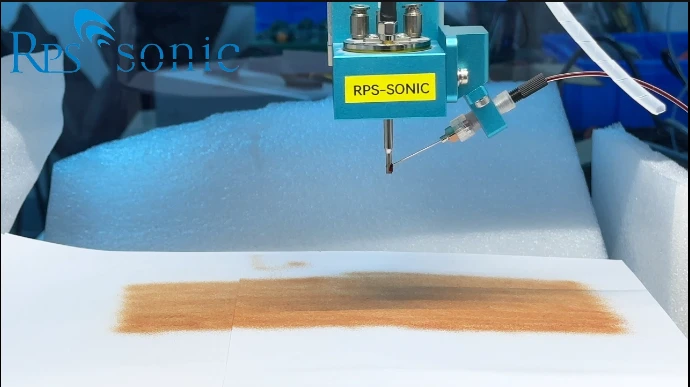
No heating or chemical additives are required during atomization, which fully preserves the original chemical properties and photosensitive stability of photoresist, avoiding denaturation or performance degradation of expensive specialty resists such as chemically amplified photoresist. The atomized droplets move toward substrates at extremely low velocity-only 1% of the spray speed of conventional air nozzles-so droplets land softly without splashing, rebound or overspray contamination. This core working principle fundamentally solves the most stubborn defects of traditional photoresist coating processes.
Four Unique Innovative Advantages of Ultrasonic Photoresist Spraying
1. Near-Perfect Uniform Coating, Ideal for 3D Structured Substrates
Spin coating fails severely on wafers with deep trenches, TSV through-silicon vias, MEMS micro-grooves and uneven topography: centrifugal force pulls resist outward, leaving ultra-thin layers at trench bottoms and thick edge beads that ruin lithography resolution. Conventional pressure spraying produces inconsistent droplet sizes, causing stripe patterns and thickness deviation across large substrates.
Ultrasonic atomization generates tightly distributed micro-droplets adjustable from 1μm to 40μm according to nozzle frequency. Tiny droplets can penetrate deep into high-aspect-ratio microstructures under mild shaping airflow, achieving conformal coverage on vertical sidewalls and recessed cavities. The finished photoresist film thickness can be precisely locked between 0.1μm and 40μm with thickness deviation controlled within ±5%, eliminating pinholes, orange peel textures and edge bead issues completely. It works seamlessly on flat silicon wafers, curved glass panels, microfluidic chips and irregular ceramic substrates alike.
2. 4X Higher Photoresist Utilization Rate, Dramatically Cutting Production Costs
Photoresist ranks among the costliest raw materials in semiconductor manufacturing, with premium formulations priced at hundreds of US dollars per gallon. Spin coating wastes over 99% of resist via centrifugal throwing away; pneumatic two-fluid spraying loses more than 75% of material to overspray and splashing.
Ultrasonic spraying features precise micro-flow control with a minimum flow rate of 0.01ml/min and directional soft deposition. Material utilization reaches over 90%, four times higher than standard two-fluid spraying. For 200mm wafer mass production, factories can slash photoresist consumption by 60%-75%, bringing huge long-term cost savings for R&D labs and medium-to-high volume production lines. Less wasted chemical solvent also lowers volatile organic compound emissions, supporting cleanroom environmental compliance and reducing waste disposal expenses.
3. Ultra-High Controllability & Zero Clogging for Stable Continuous Production
The whole ultrasonic coating system integrates RS485 communication, 7-inch LCD precision syringe liquid supply pumps and programmable three-axis motion platforms. Operators can independently adjust ultrasonic power, spray scanning speed, liquid flow rate and fan spray width (2mm to 100mm) to customize photoresist film parameters for different lithography recipes. Multiple nozzle types-probe-type for inner tube spraying, wide parallel nozzles for large-area panels, 120kHz micro nozzles for tiny micro-devices, vacuum flange nozzles for vacuum chamber coating-support fully customized production demands.
Since atomization relies solely on ultrasonic vibration instead of high-pressure liquid extrusion, there is no narrow pressure channel prone to blockage. The nozzle contact surface is made of corrosion-resistant titanium alloy, compatible with low-viscosity photoresist below 100cps and solid content under 10%. Frequent shutdowns for nozzle cleaning and maintenance are eliminated, greatly improving equipment uptime in cleanroom production.
4. Low Contamination, Cleanroom-Grade Compatibility
Traditional high-pressure spraying generates massive rebound droplets that float in cleanroom air, introducing particle contamination that triggers chip failure. Ultrasonic spraying uses minimal auxiliary air, with soft spray eliminating droplet bounce-back. The whole machine can be upgraded to full cleanroom configuration with anti-static and anti-corrosion treatment, meeting strict class 100/1000 cleanroom standards for semiconductor and optoelectronic production. The low-impact deposition also avoids mechanical scratch damage to fragile thin wafers and flexible transparent conductive film substrates.
Main Industrial Application Scenarios of Ultrasonic Photoresist Coating Technology
Semiconductor Wafer & Advanced Packaging
Ideal for photoresist coating on silicon wafers, silicon carbide third-gen semiconductor substrates, TSV packaging structures and wafer-level packaging. It stabilizes pattern resolution for micro-nano lithography and reduces device scrapping caused by uneven resist coverage.MEMS & Microfluidic Chips
Perfect for coating micro-groove, micro-channel and sensor cavity structures where spin coating cannot deliver uniform sidewall coverage, supporting medical biosensor and micro-electromechanical component mass manufacturing.Flat Panel & Optical Glass Industry
Suitable for photoresist coating on float glass, optical lens, transparent conductive film and large-size display panels; wide-spray ultrasonic nozzles cover substrates up to 24 inches with consistent film thickness.R&D Laboratory Small-Batch Testing
Benchtop ultrasonic coating machines (P300, P400 series) offer compact semi-automatic and fully programmable XYZ motion platforms with small working areas for university labs and material research institutes to conduct photoresist formulation testing and process verification before mass production.Special Precision Devices
Custom vacuum and high-temperature ultrasonic nozzle versions support photoresist coating under vacuum environment or heated substrate conditions for special lithography processes.
RPS-SONIC Integrated Ultrasonic Photoresist Coating Solutions
We provide one-stop ultrasonic atomization coating systems tailored for photoresist deposition, covering all core components: frequency-customized titanium ultrasonic nozzles, high-frequency ultrasonic generators, high-precision constant-flow syringe pumps, and full series automatic coating machines from lab-scale small equipment to mass-production three-axis robot systems.
All equipment supports Windows programmable operation with teach pendant trajectory editing, and optional upgrades including substrate heating, vacuum adsorption, nozzle rotation/tilt and corrosive material compatible kits. Our technical team delivers customized process parameter debugging according to customers' photoresist viscosity, substrate size and target film thickness, helping manufacturers quickly replace outdated spin or pneumatic spraying lines and upgrade lithography coating efficiency.
Conclusion
As microfabrication advances toward smaller feature sizes, complex 3D structures and stricter cost control, traditional photoresist coating technologies can no longer match production demands. Ultrasonic atomization spraying stands out as a forward-looking, sustainable precision coating technology that balances ultra-uniform thin-film quality, dramatic raw material savings, low contamination and flexible process adaptability.
Whether you operate a semiconductor mass production factory, an optoelectronic glass processing plant, a MEMS component workshop or an academic research laboratory, ultrasonic photoresist coating systems deliver measurable improvements in product yield, manufacturing cost and environmental performance-an essential upgrade path for next-generation lithography manufacturing.
For customized nozzle selection, equipment quotation and photoresist coating process testing, contact our professional engineering team for targeted technical support.