

How Does Ultrasonic Wastewater Treatment Improve Water Purification Efficiency?
Jun 30, 2026
Ultrasonic homogenizers utilize high-frequency vibrations to generate a strong cavitation effect in liquids, achieving the breaking down, dispersion, and enhanced reaction of waste materials through localized high temperature and pressure. This technology is playing a significant role in wastewater treatment.
Ultrasonic homogenizers generate high-frequency vibrations in wastewater through a probe, creating numerous tiny bubbles within the liquid. When these bubbles burst, they release instantaneous high energy, resulting in the following effects:
Strong shear force: destroys the structure of pollutants
Microjet impact: decomposes large suspended particles
Localized high temperature and pressure: promotes chemical reactions
Free radical generation (·OH, etc.): enhances oxidative degradation ability
These effects collectively improve the treatment efficiency of organic pollutants and recalcitrant substances in wastewater.
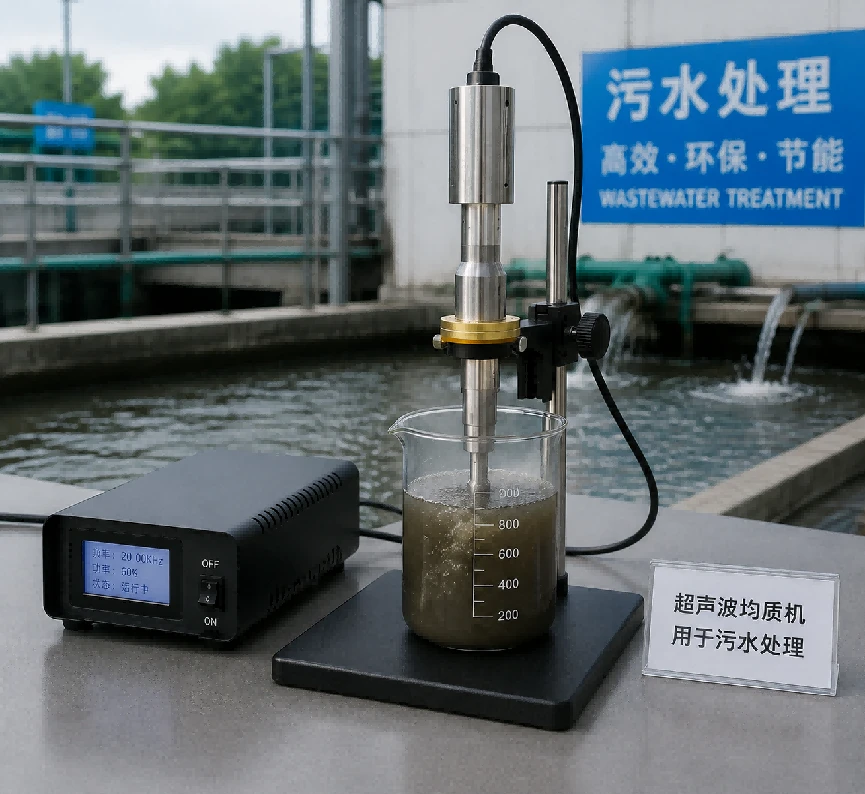
Main Applications of RPS-SONIC in Wastewater Treatment
1. Industrial organic wastewater degradation
RPS-SONIC equipment is suitable for a variety of challenging industrial wastewaters, including:
Dyeing and printing wastewater (dye molecules have complex structures)
Pharmaceutical wastewater (containing antibiotics and organic intermediates)
Petrochemical wastewater (containing benzene and high molecular weight organic matter)
Food processing wastewater (high COD, high oil content)
Ultrasonic waves can effectively disrupt the structure of macromolecules and improve the biodegradability of wastewater.
2. Sludge decomposition and volume reduction treatment
In the sludge treatment process, the RPS-SONIC homogenizer can:
Breaking the sludge floc structure
Release of intracellular organic matter
Improve the efficiency of subsequent anaerobic digestion
Significantly reduce sludge volume
This is of great significance for reducing sludge disposal costs.
3. Pretreatment of recalcitrant pollutants
For pollutants that are difficult to degrade using traditional biochemical methods, ultrasound can be used as a pretreatment enhancement method.:
Degradation dyes and surfactants
Destroy oil emulsification system
Reduce COD and TOC
Improve the stability of subsequent biochemical systems
Typical application process flow
The typical process of using the RPS-SONIC ultrasonic homogenizer in a wastewater system is as follows:
Raw water → Equalization tank → Ultrasonic treatment (RPS-SONIC) → Advanced oxidation/biochemical treatment → Sedimentation/filtration → Discharge meeting standards.
The ultrasonic unit is usually used as the "core of enhanced pretreatment," significantly improving the overall system efficiency.