

Ultrasonic Aqueous Extraction Of Kava Powder: An Efficient Solution Revolutionizing Traditional Manual Squeezing Methods
May 23, 2026
As a traditional medicinal plant, Kava contains kavalactones within its root powder, which serve as the core active ingredients responsible for its soothing, relaxing, sedative, and anti-anxiety effects. Traditional Kava extraction typically employs a ratio of "1 liter of water to 25g of powder," relying on manual kneading and squeezing to extract the active compounds-a method characterized by low efficiency and significant loss of active ingredients. In contrast, ultrasonic extraction technology-leveraging the physical phenomenon of cavitation-enables highly efficient, low-temperature, and uniform extraction using the exact same ratio, thereby serving as a perfect replacement for the traditional manual squeezing process. This article, utilizing the RPS-SONIC 20kHz 3000W ultrasonic extraction system as a case study, provides a detailed analysis of the fundamental differences between the two processes and highlights the distinct advantages offered by ultrasonic extraction.
I. Core Ratios for Aqueous Kava Powder Extraction and the Traditional Manual Squeezing Process
(I) Standard Ratio: 1L Water : 25g Kava Powder
This ratio represents the classic standard for aqueous Kava extraction; it strikes an optimal balance between the solubility of active ingredients and extraction efficiency. Applicable to various scenarios-including both manual and ultrasonic extraction methods-this ratio ensures the thorough dissolution of effective compounds (such as kavalactones) into the water while simultaneously preventing powder wastage or issues related to the solution being either too concentrated or too dilute.
(II) Traditional Manual Squeezing Process: Principles, Procedures, and Key Pain Points
Manual squeezing is the original, rudimentary method for extracting Kava. It relies fundamentally on human physical force to compress and rupture the cell walls of the Kava powder, thereby allowing the active ingredients to dissolve into the water.
Process Flow: Mix according to the 1L water : 25g powder ratio → Manually stir to ensure thorough wetting (5–10 minutes) → Repeatedly knead and squeeze the powder with both hands (continuously for 15–30 minutes) → Filter the residue using cheesecloth or gauze → Obtain the extracted liquid.
Key Pain Points
Low Extraction Yield and Loss of Active Ingredients: Manual squeezing is capable of rupturing only the superficial cell layers; the cell-wall rupture rate for deeper cells remains below 30%. Consequently, the extraction yield for kavalactones stands at a mere 40%–50%, resulting in the significant wastage of valuable active ingredients that remain trapped within the discarded residue. Time-consuming, Labor-intensive, and Inefficient: Processing a single batch requires over 30 minutes, resulting in high labor costs and an inability to scale up production. Furthermore, inconsistent kneading pressure leads to significant variations in extract concentration between batches.
High Impurity Levels and Unstable Quality: Manual kneading easily introduces impurities-such as skin oils and sweat-into the mixture. Additionally, the powder particles are crushed unevenly; consequently, the filtered extract often retains fine residues, appearing turbid and being prone to spoilage.
Susceptibility of Active Ingredients to Degradation: The friction generated during manual kneading creates heat, causing localized temperatures to exceed 60°C. This exposes heat-sensitive compounds-such as kavalactones-to oxidation and decomposition, thereby diminishing the therapeutic potency of the extract.
II. Core Principles of Ultrasonic Extraction Technology
Ultrasonic extraction harnesses the combined physical effects of low-frequency (20 kHz), high-intensity ultrasound-specifically cavitation, mechanical action, and thermal effects-to instantaneously disrupt the cell walls of kava powder at ambient temperatures (40–50°C), thereby accelerating the release of active ingredients.
Cavitation Effect (The Core Principle): As ultrasonic waves propagate through water, they generate rapid cycles of positive and negative pressure, giving rise to countless micro-bubbles. The instantaneous collapse of these bubbles releases transient pressures reaching 3,000 MPa, accompanied by high-velocity micro-jets. These forces directly "bombard" and rupture the kava cells, facilitating the rapid release of active ingredients from deep within the plant tissue.
Mechanical Effect: The high-frequency vibration of the ultrasound (20,000 cycles per second) generates intense agitation and shear forces. This ensures thorough mixing of the kava powder with the water, significantly increasing the solid-liquid contact surface area and accelerating the diffusion of active ingredients.
Low-Temperature Thermal Effect: The ultrasonic process generates only mild heat (40–50°C), thereby preventing high temperatures from degrading heat-sensitive kavalactones. Simultaneously, this gentle thermal effect increases the kinetic energy of molecules, further promoting the dissolution of the active ingredients.
III. The Core Differences Between Ultrasonic Extraction (RPS-SONIC 20k/3000W) and Traditional Manual Squeezing
(II) In-Depth Analysis of Key Differences
Cell Disruption Efficiency: From "Surface Rubbing" to "Complete Cell Rupture"
Traditional manual squeezing can only compress the surface layer of the powder; the deeper cells remain intact, keeping active ingredients locked within the cells. In contrast, the cavitation bubbles generated by the RPS-SONIC 20kHz ultrasonic system can penetrate deep into the interior of the powder particles. This results in a cell disruption rate exceeding 90%, thoroughly releasing active ingredients such as kavalactones and flavonoids, while reducing the residual active ingredient content in the spent residue to less than 5%.
Extraction Quality: From "Turbid Impurities" to "Pure and Highly Active"
Manual extraction fluids often suffer from partial oxidation of kavalactones due to heat generated by friction; furthermore, they contain fine powder particles and impurities, making them prone to stratification and spoilage. Ultrasonic extraction, however, operates at low temperatures throughout the entire process, ensuring an active ingredient retention rate exceeding 95%. Additionally, the shear forces generated by the ultrasonic waves refine the powder particles; consequently, the extracted liquid is crystal-clear and free of impurities after filtration, extending its shelf life by 2 to 3 times.
Production Model: From "Manual Workshop" to "Automated Industrialization"
Traditional manual squeezing relies heavily on human labor and involves small batch sizes, rendering it incapable of meeting large-scale market demands. The RPS-SONIC 20kHz 3000W equipment, conversely, supports continuous-flow extraction and can be seamlessly integrated into existing production lines. Operating at a ratio of 1 liter of water to 25 grams of powder, the system automatically handles feeding, ultrasonic extraction, filtration, and discharge. This fully automated process significantly reduces labor costs and is adaptable to production scenarios ranging from small-to-medium scale operations to large-scale industrial manufacturing. IV. RPS-SONIC 20kHz 3000W Ultrasonic Extraction Equipment: The Ideal Choice for Kava Extraction
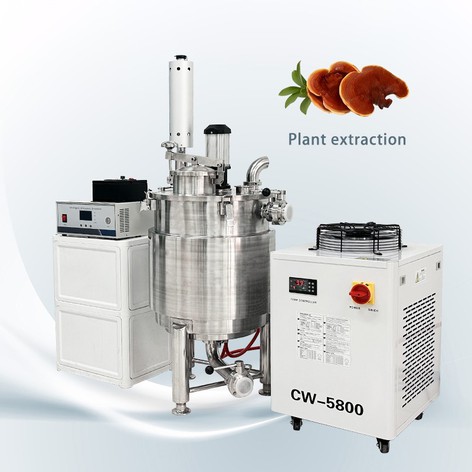
(I) Core Equipment Parameters
Model: RPS-SONO20-3000 (20kHz, 3000W)
Frequency: 20 ± 0.5 kHz (Low frequency, high intensity; optimized for plant cell disruption)
Power: 3000W (Ample power, strong cavitation effect; suitable for batch extractions of 10–200L)
Materials: Titanium alloy probe (Corrosion-resistant, high-strength; suitable for water-based extraction) + 304 Stainless Steel Chamber (Food-grade, safe, and hygienic)
Control: Digital Intelligent Generator (Precise control of time, power, and temperature; parameters are storable, ensuring 100% batch-to-batch repeatability)
(II) Core Advantages of the Equipment for Kava Extraction
Precise Optimization for the Standard 1L:25g Ratio
The equipment supports precise control of the solid-to-liquid ratio. Based on the standard ratio of 1L of water to 25g of kava powder, it automatically adjusts the ultrasonic power and duration to ensure maximum extraction yield-eliminating the need for repeated manual calibration.
Low-Temperature, High-Efficiency Extraction: Maximizing Active Ingredient Retention
The 20kHz low-frequency ultrasonic cavitation effect is gentle, maintaining the extraction temperature stably between 40–50°C, thereby completely preventing the oxidative degradation of kavalactones. The high-power 3000W output rapidly generates a high-intensity cavitation field, completing the extraction within just 15 minutes-an efficiency far surpassing that of traditional manual squeezing methods.
Simple Operation and Low Maintenance Costs
The equipment features a modular design; the probe can be quickly detached for cleaning, and the chamber is designed without dead corners to meet food-grade hygiene standards. The intelligent control panel allows for one-touch startup; no specialized technical personnel are required-general workers can operate the system after simple training, resulting in maintenance costs that are significantly lower than manual labor costs.
Safe, Eco-Friendly, and Free of Secondary Pollution
The entire process utilizes physical extraction, requiring no chemical additives and using only water as a solvent, resulting in zero wastewater or exhaust emissions. The titanium alloy probe and stainless steel chamber ensure no heavy metal leaching occurs, yielding an extract that is safe, pure, and fully compliant with industry standards for food and health supplements. V. Conclusion: Ultrasonic Extraction-The Inevitable Trend in Kava Processing Upgrades
Under the standard ratio of 25g of kava powder per 1 liter of water, the traditional manual squeezing method-plagued by low extraction yields, poor efficiency, inconsistent quality, and high labor costs-can no longer meet the production demands of modern kava products. In contrast, the RPS-SONIC 20kHz 3000W ultrasonic extraction system offers core advantages such as cavitation-induced cell disruption, high efficiency at low temperatures, automated controllability, and eco-friendly safety. By leveraging these strengths, it boosts the extraction rate of kavalactones from 40–50% to 85–95% and reduces extraction time by more than two-thirds, all while ensuring that the resulting extract is pure, highly active, and consistent across batches-thereby serving as a perfect replacement for the traditional manual squeezing process.
For kava processing enterprises, adopting the RPS-SONIC ultrasonic extraction system not only lowers costs, boosts production capacity, and enhances product quality, but also drives the evolution of kava extraction processes-transitioning them from traditional manual methods to modern, standardized, and industrialized operations-thereby fostering the high-quality development of the entire kava industry.