

Ultrasonic Atomization Spray Coating Of Titanium Dioxide Slurry
Dec 30, 2025
Titanium dioxide (TiO₂) is a functional material with high refractive index, excellent chemical stability, and optical properties. The quality of the sprayed film of its slurry directly determines the performance of the final product. In the titanium dioxide slurry spraying process, ultrasonic atomization spray coating technology, with its unique atomization mechanism and precise control capabilities, is gradually replacing traditional spraying processes and becoming a core technology solution for the preparation of high-end functional thin films. The ultrasonic nozzle, as the core execution component, directly determines the atomization effect, coating uniformity, and material utilization rate, and is crucial for ensuring process stability and product consistency. This article will focus on a detailed analysis of the technical core, selection logic, and industry applications of ultrasonic atomization spray coating of titanium dioxide slurry.

Why choose ultrasonic technology for spraying titanium dioxide slurry? Traditional spraying processes (such as air spraying and high-pressure airless spraying) generally suffer from problems such as uneven atomization particle size, numerous pinhole defects in the coating, and serious material waste when processing titanium dioxide slurry. The core requirement for titanium dioxide slurry film formation is to form a dense, uniform thin film layer to ensure its optical properties (such as light transmittance and anti-reflection) or protective properties. However, the atomization mechanism of traditional processes relies on airflow impact or high-pressure extrusion, which easily leads to titanium dioxide particle agglomeration and a wide distribution of atomization particle sizes, resulting in large fluctuations in coating thickness and unstable performance.
The core advantage of ultrasonic atomization spray coating technology stems from its unique atomization principle, which uses the high-frequency vibration (usually 40kHz-120kHz) of the ultrasonic nozzle to cause violent mechanical vibration of the titanium dioxide slurry on the nozzle surface, forming a uniform droplet mist field at the micron or even nanometer level, rather than relying on airflow shearing. This atomization method fundamentally addresses the pain points of traditional processes: Firstly, the high-frequency vibration of the ultrasonic nozzle simultaneously achieves secondary dispersion of the slurry, effectively breaking up the agglomeration of titanium dioxide particles and ensuring uniform distribution of titanium dioxide particles in the atomized droplets; secondly, the atomized droplets have extremely high size consistency, typically controllable within the range of 1-50 μm, and the spray field distribution is conically symmetrical, laying the foundation for the formation of a uniform and dense coating; thirdly, the ultrasonic atomization process does not require high-pressure airflow assistance, and the droplet kinetic energy is gentle, avoiding impact damage to the substrate surface caused by airflow, while significantly reducing slurry rebound waste, resulting in a material utilization rate of over 85%, far exceeding the 30%-50% of traditional processes; fourthly, the ultrasonic nozzle adopts a non-contact atomization design, eliminating the risk of nozzle clogging, especially suitable for systems containing solid particles such as titanium dioxide slurry, significantly improving process stability and reducing equipment downtime for maintenance.
The core role of the ultrasonic nozzle in titanium dioxide slurry spraying runs throughout the entire process, and its design precision directly affects the final coating quality. A high-quality ultrasonic nozzle needs to have a structural design that matches the characteristics of titanium dioxide slurry: on the one hand, the vibration surface material of the nozzle must be made of wear-resistant and corrosion-resistant special materials (such as titanium alloy, zirconia ceramic), which can withstand the long-term erosion of titanium dioxide particles and avoid the attenuation of atomization effect caused by material wear; on the other hand, the nozzle needs to be equipped with a precise slurry delivery channel and flow control module, combined with the adjustability of high-frequency vibration parameters, to adapt to titanium dioxide slurries of different viscosities (usually 1-100cps), achieving precise thickness control from thin coatings (tens of nanometers) to thick coatings (tens of micrometers). In addition, some high-end ultrasonic nozzles also integrate heating and insulation functions, allowing for precise temperature control based on the temperature sensitivity of the titanium dioxide slurry, preventing viscosity changes caused by temperature fluctuations during the atomization process, further ensuring atomization stability. In practical applications, by adjusting the vibration frequency of the ultrasonic nozzle, the slurry supply flow rate, and the relative motion parameters between the nozzle and the substrate, precise control of the porosity, density, and surface roughness of the titanium dioxide coating can be achieved, meeting the performance requirements of different end products.

From an industry application perspective, ultrasonic titanium dioxide slurry atomization spraying technology, with its excellent film-forming performance, has been widely adopted in several core fields, including photovoltaics, architectural glass, electronics and optics, and new energy. Its applications focus on the preparation of functional thin films, which can be broadly categorized into the following three types:
The photovoltaic industry is a core application area for ultrasonic titanium dioxide slurry spraying, mainly used in the preparation of anti-reflective coatings for photovoltaic glass. The photoelectric conversion efficiency of photovoltaic modules is directly related to the utilization rate of incident light. Preparing a titanium dioxide anti-reflective coating on the surface of photovoltaic glass can reduce light reflectivity and increase light transmittance through the high refractive index characteristics of titanium dioxide, thereby improving the power generation efficiency of photovoltaic cells. The titanium dioxide anti-reflective coating applied using ultrasonic nozzles offers advantages such as good uniformity, high light transmittance (a 3%-5% increase), and strong wear and weather resistance, making it suitable for long-term use in complex outdoor environments. Its high material utilization rate also reduces the manufacturing cost of photovoltaic modules, contributing to cost reduction and efficiency improvement in the photovoltaic industry. In addition, in the preparation of protective coatings for photovoltaic cell backsheets, the protective layer formed by ultrasonic spraying of titanium dioxide slurry can improve the backsheet's resistance to UV aging and humid heat, extending the service life of photovoltaic modules.
In the architectural and automotive glass industries, ultrasonic titanium dioxide slurry spraying is mainly used to prepare self-cleaning glass functional layers. Titanium dioxide has excellent photocatalytic properties; under ultraviolet light irradiation, it can decompose organic pollutants on the surface. Its superhydrophilic properties allow rainwater to form a water film on the glass surface, washing away the decomposed pollutants and achieving a self-cleaning effect. Traditional methods for preparing self-cleaning glass coatings often suffer from problems such as uneven coating and poor adhesion. However, the precise atomization capabilities of ultrasonic spray nozzles allow for uniform coverage of the glass surface with titanium dioxide slurry, resulting in a coating that adheres tightly to the substrate and ensures the uniformity and durability of the self-cleaning function. This type of self-cleaning glass is widely used in applications such as high-rise building exterior glass and automotive windshields, significantly reducing cleaning and maintenance costs and improving safety.
In the optoelectronics and new energy industries, ultrasonic titanium dioxide slurry spraying is used to prepare functional optical films and protective coatings. In the field of electronic displays, high-refractive-index films formed by ultrasonic spraying of titanium dioxide slurry can be used as optical brightening layers for display panels, improving display brightness and contrast. In the field of new energy batteries, during the modification of cathode materials in some new types of batteries, ultrasonic spraying of titanium dioxide slurry can form a coating layer, improving the cycle stability and safety of the cathode material. Furthermore, in applications such as anti-reflective coatings for optical instrument lenses and light-shielding layers for special coatings, ultrasonic titanium dioxide slurry spraying technology, with its precise film formation control capabilities, meets the stringent performance requirements of high-end products.
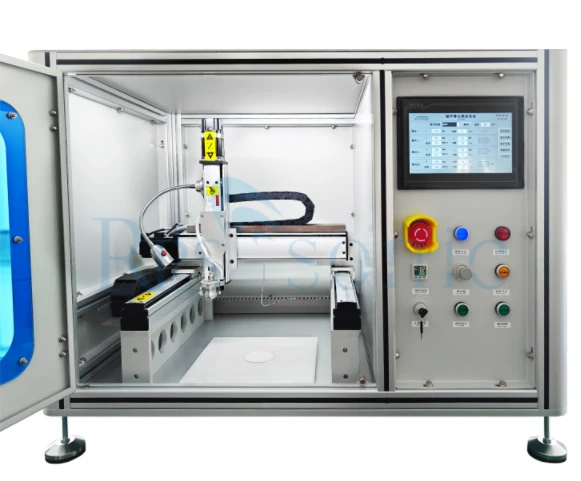
In summary, the core advantage of ultrasonic titanium dioxide slurry atomization spraying technology stems from the high-frequency vibration atomization mechanism of the ultrasonic spray nozzle. This not only solves many of the problems of traditional processes but also enables the precise and controllable preparation of titanium dioxide coatings. As the demand for high-end functional films in the photovoltaic, electronics, and construction industries continues to increase, the technological upgrades and process optimization of ultrasonic spray nozzles will further promote the application expansion of titanium dioxide slurry spraying technology, providing core technical support for the high-quality development of related industries.